' \
....
"currency": "JPY",
...
"items": [
{
"skuId": "sku-dig-subscription-01",
"quantity": 1,
"price": 459
}
],
"shoppingCountry": "JP",
...
"options": {
...
"addresses": [
{
"address": {
"line1": "10380 Bren Rd W",
"line2": "line 2",
"city": "Minnetonka",
"postalCode": "55129",
"state": "MN",
"country": "US"
},
"name": "John Smith",
"phone": "952-111-1111",
"email": "jsmith@digitalriver.com",
"organization": "Digital River"
},
{
"address": {
"line1": "62 Trinity Crescent",
"line2": "",
"city": "WHITCHURCH",
"postalCode": "CF4 9ZB",
"country": "GB"
},
"name": "Brenna Brawner",
"phone": "07854319925",
"email": "anna@dr.com",
"organization": "Digital River"
}
]
}
}'
```
{% endtab %}
{% tab title="Delivery information" %}
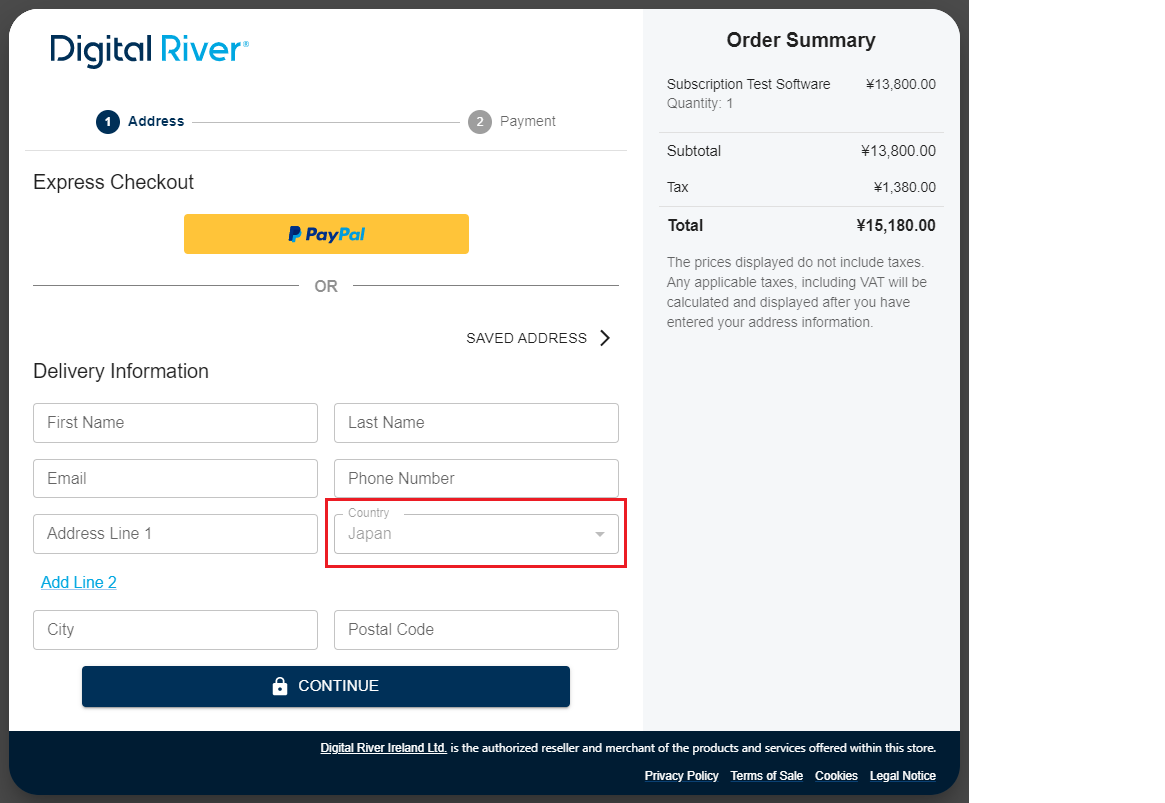
As a result, the country drop-down menu in the delivery information stage is locked.
{% endtab %}
{% tab title="Billing information" %}
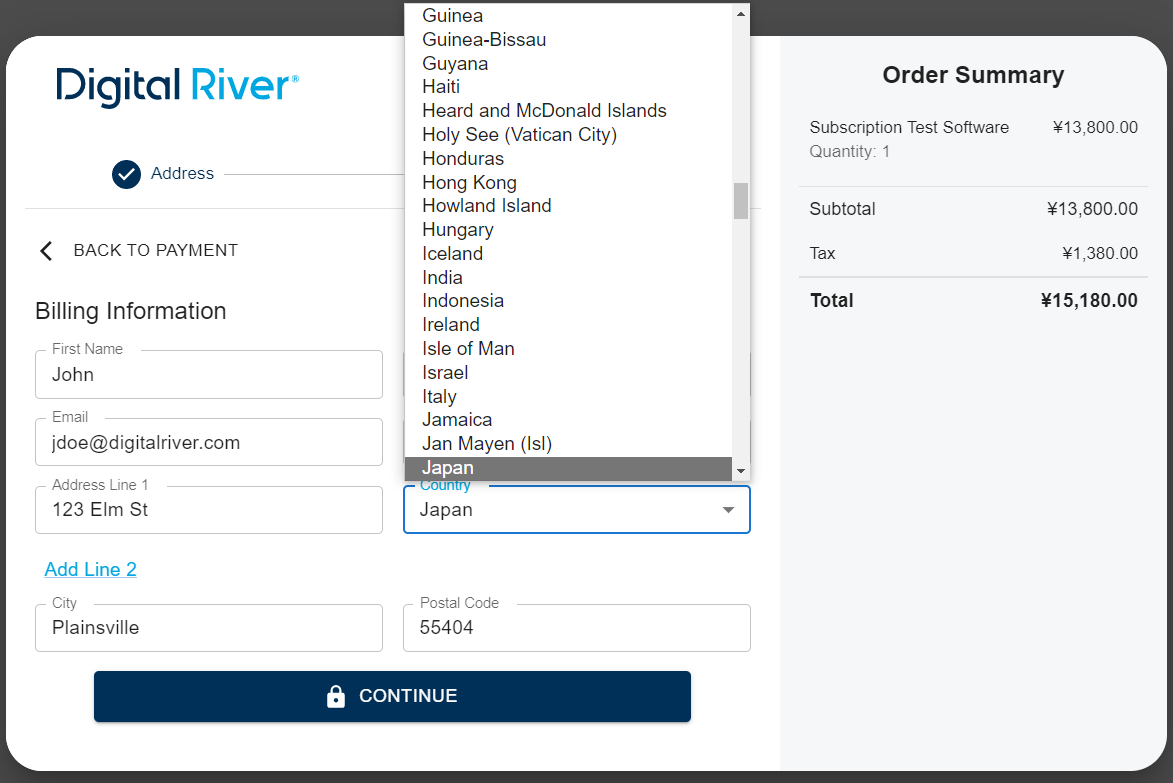
In the billing information stage, however, the country selector remains operational.
**Prebuilt Checkout**
**Components**
{% endtab %}
{% tab title="Events" %}
And even though [`items[]`](#product-data) only references [digital products](https://docs.digitalriver.com/digital-river-api/product-management/skus#how-products-are-classified-as-physical-or-digital), the [`checkout_session.order.created`](https://docs.digitalriver.com/digital-river-api-reference/2021-12-13/drop-in-checkout-sessions/spaces/-LqH4RJfLVLuHPXuJyTZ/pages/okHqAQ9d1PaLPLjq6nZF#checkout_session.order.created) and `order.*` [events ](https://docs.digitalriver.com/digital-river-api/order-management/events-and-webhooks-1/events-1)contain `shipTo.address.country`.
{% code title="order.accepted" %}
```json
{
"id": "6ea4f842-0da7-488b-a078-50444df607b6",
"type": "order.accepted",
"data": {
"object": {
"id": "246318070336",
...
"shipTo": {
"address": {
"country": "JP"
}
},
...
"billTo": {
"address": {
"line1": "123 My St",
"city": "Tokyo",
"postalCode": "100-0013",
"country": "JP"
},
...
},
...
"items": [
{
"id": "175174880336",
"skuId": "sku-dig-subscription-01",
...
}
],
...
}
},
...
}
```
{% endcode %}
{% endtab %}
{% endtabs %}
The `shoppingCountry` also plays a role in determining:
* What [address validations](https://docs.digitalriver.com/digital-river-api/integration-options/checkouts/creating-checkouts/providing-address-information#address-requirements-and-validations) a customer's inputs are subjected to.
* Whether customers are shown a form that collects their tax identification number and whether they have the option to enter a value or are required to do so.
* The options are displayed in the payment collection stage.
* The designated [selling entity](https://docs.digitalriver.com/digital-river-api/integration-options/checkouts/creating-checkouts/selling-entities) affects what compliance disclosures are displayed and whether a [purchase invoice](https://docs.digitalriver.com/digital-river-api/order-management/accessing-invoices-and-credit-memos) is eventually generated.
## Ship from
If [`items[]`](#product-data) contains [physical products](https://docs.digitalriver.com/digital-river-api/product-management/skus#how-products-are-classified-as-physical-or-digital), then your [checkout-session](/digital-river-api-reference/2021-12-13/drop-in-checkout-sessions.md) needs to meet certain `shipFrom.address` requirements.
Refer to [Ship from requirements](https://docs.digitalriver.com/digital-river-api/integration-options/checkouts/creating-checkouts/providing-address-information#ship-from-requirements) on the [Providing address information](https://docs.digitalriver.com/digital-river-api/integration-options/checkouts/creating-checkouts/providing-address-information) page for details. There, you will find [checkout ](/digital-river-api-reference/2021-12-13/checkouts.md)requirements, which the checkout-session wraps.
To get this data added to the checkout-session, you can:
* Send `shipFrom` in a [create checkout-session request](/digital-river-api-reference/2021-12-13/drop-in-checkout-sessions.md#drop-in-checkout-sessions).
* [Save a default ship-from address in the Digital River Dashboard](https://docs.digitalriver.com/digital-river-api/administration/dashboard/settings/prebuilt-checkout#create-the-prebuilt-checkout-configuration). If you do this, then any `shipFrom` values sent in a [`POST /drop-in/checkout-sessions`](/digital-river-api-reference/2021-12-13/drop-in-checkout-sessions.md#drop-in-checkout-sessions) override (but don't overwrite) those saved in the Digital River Dashboard.
* [Use a shipping endpoint](https://docs.digitalriver.com/digital-river-api/integration-options/low-code-checkouts/using-a-shipping-endpoint) to dynamically provide Digital River with one or more `shipFrom` locations during the checkout process.
## Customer type
The [checkout-session's](/digital-river-api-reference/2021-12-13/drop-in-checkout-sessions.md) `customerType` indicates whether customers are purchasing an `individual` or on behalf of a `business`.
If `customerType` is `business`, customers must enter their company's name in the shipping and billing information collection forms.
In many cases, a value of `business` is required to activate the tax identifier collection form. For details, refer to [Supported tax identifiers](https://docs.digitalriver.com/digital-river-api/integration-options/checkouts/creating-checkouts/tax-identifiers#supported-tax-identifiers).
### Auto collect customer type
You can pass [`customerType`](#customer-type) in a [create checkout-session request](/digital-river-api-reference/2021-12-13/drop-in-checkout-sessions.md#drop-in-checkout-sessions). But to do so, you'll need to have this information before initiating checkout.
If you'd like Digital River to ask customers during the checkout process whether they're purchasing on behalf of a business, then you'll need to [turn on this feature in Digital River Dashboard](https://docs.digitalriver.com/digital-river-api/administration/dashboard/settings/prebuilt-checkout), and your [`POST /drop-in/checkout-sessions`](/digital-river-api-reference/2021-12-13/drop-in-checkout-sessions.md) must (1) omit `customerType` (2) or assign a value of `individual` or `null` to this parameter.
For details, refer to:
* [B2B transactions](https://docs.digitalriver.com/digital-river-api/integration-options/low-code-checkouts/drop-in-checkout#business-to-business-transactions) in the [Name and address stage](https://docs.digitalriver.com/digital-river-api/integration-options/low-code-checkouts/drop-in-checkout#name-and-address) on the [Prebuilt Checkout](https://docs.digitalriver.com/digital-river-api/integration-options/low-code-checkouts/drop-in-checkout) page
* [Business to business transactions](https://docs.digitalriver.com/digital-river-api/developer-resources/digitalrivercheckout.js-reference/digitalrivercheckout-object/components/address-component#business-to-business-transactions) on the [Address Component](https://docs.digitalriver.com/digital-river-api/developer-resources/digitalrivercheckout.js-reference/digitalrivercheckout-object/components/address-component) page.
## Tax-inclusive
The `taxInclusive` boolean determines how we treat product prices when calculating tax.
It also dictates how prices are displayed in the checkout experience. The default value is `false`. If you set `taxInclusive` to `true`, then the experience indicates that the total amount includes VAT.
## Registered customers
For checkouts initiated by a registered customer, your [create checkout-session request](/digital-river-api-reference/2021-12-13/drop-in-checkout-sessions.md#drop-in-checkout-sessions) can include the following:
* [A customer identifier](#customer-identifier)
* [Saved addresses](#saved-addresses)
### Customer identifier
To check out customers registered in your system, send their `customerId`.
```json
{
...
"customerId": "230f61be-8822-4325-9926-e9d0731691b4"
...
}
```
Digital River uses this value to determine whether a [customer](/digital-river-api-reference/2021-12-13/customers.md) with that identifier exists in our system.
If it does, we retrieve that [customer's ](/digital-river-api-reference/2021-12-13/customers.md)transaction-applicable [`taxIdentifiers`](https://docs.digitalriver.com/digital-river-api/integration-options/checkouts/creating-checkouts/tax-identifiers)`[]` and payment [`sources[]`](https://docs.digitalriver.com/digital-river-api/payments/payment-sources) and, for convenience purposes, present them as options in the tax identifier and payment collection forms.
If the [customer](/digital-river-api-reference/2021-12-13/customers.md) doesn’t yet exist in our system, we create a new object and assign it the `customerId` you provided.
In either case, as registered customers progress through a [Prebuilt Checkout](https://docs.digitalriver.com/digital-river-api/integration-options/low-code-checkouts/drop-in-checkout), they can save their shipping information, tax identifiers, and billing information for future transactions. They can also do the same for their selected payment method in [Prebuilt Checkout](https://docs.digitalriver.com/digital-river-api/integration-options/low-code-checkouts/drop-in-checkout) and [Components](https://docs.digitalriver.com/digital-river-api/integration-options/low-code-checkouts/implementing-a-components-checkout).
### Saved addresses
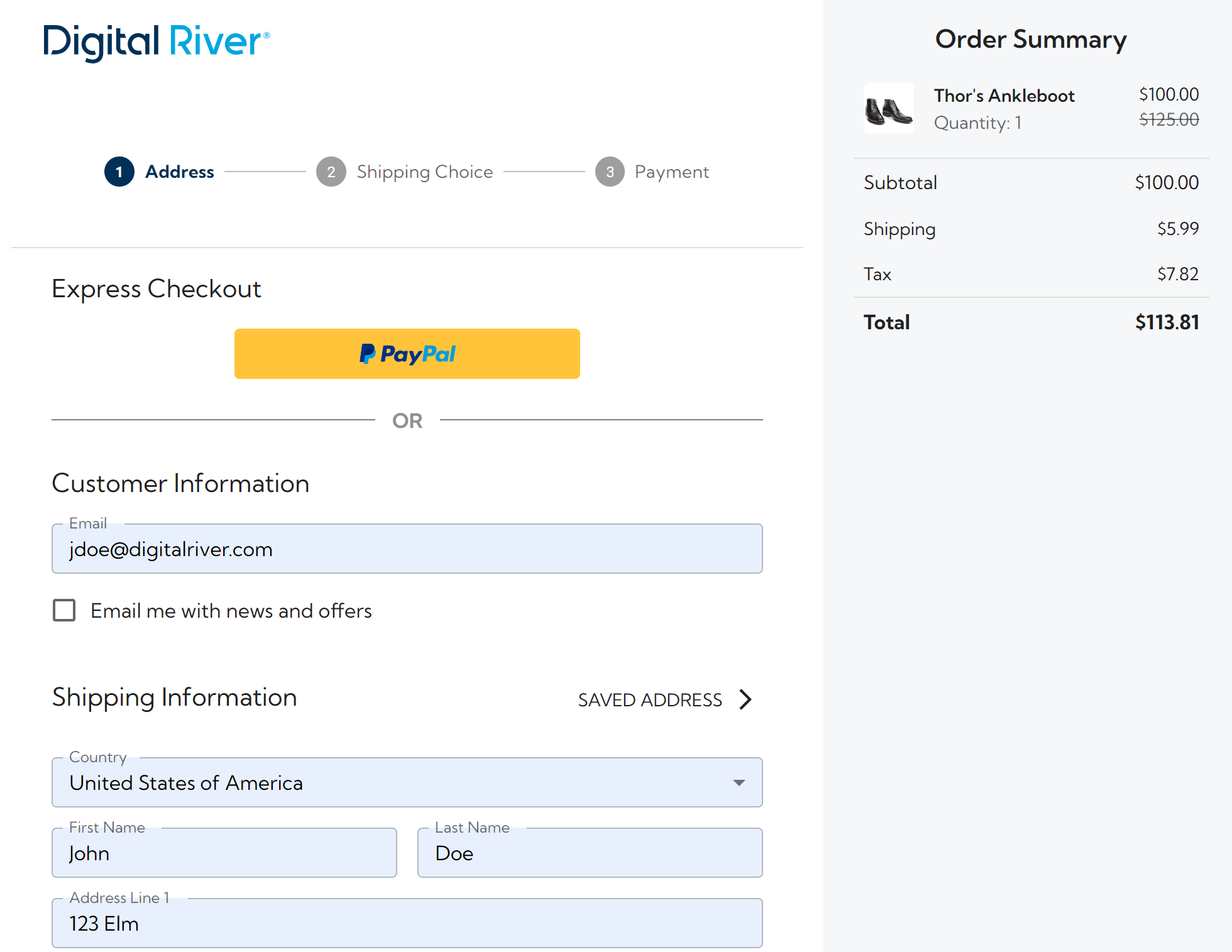
If you persist registered customers’ addresses, and the customer checking out has one or more saved values in your system, you can use `options.addresses[]` to send Digital River this data.
```json
{
...
...
"options": {
...
"addresses": [
{
"address": {
"line1": "10380 Bren Rd W",
"city": "Minnetonka",
"postalCode": "55129",
"state": "MN",
"country": "US"
},
"name": "John Smith",
"phone": "952-111-1111",
"email": "jsmith@digitalriver.com",
"organization": "Digital River",
"additionalAddressInfo": {
"neighborhood": "Centro",
"division": "営業部",
"phoneticName": "ヤマダ タロ"
}
},
{
"address": {
"line1": "62 Trinity Crescent",
"city": "WHITCHURCH",
"postalCode": "CF4 9ZB",
"country": "GB"
},
"name": "Anna Brawner",
"phone": "07854319925",
"email": "anna@dr.com",
"organization": "Digital River",
"additionalAddressInfo": {
"neighborhood": "Centro",
"division": "営業部",
"phoneticName": "ヤマダ タロ"
}
}
]
},
...
}
```
In the address collection stage, we present these saved values to customers for convenience.
{% hint style="info" %}
For each `options.addresses[]`, Digital River only displays its `name` and `address`.
{% endhint %}
## Shipping methods
If [`items[]`](#product-data) contain [physical products](https://docs.digitalriver.com/digital-river-api/product-management/skus#how-products-are-classified-as-physical-or-digital), you must provide Digital River shipping options for customers to select from. You can do this in one of the following ways:
First, you can send `options.shippingMethods[]` in the [create checkout-session request](/digital-river-api-reference/2021-12-13/drop-in-checkout-sessions.md#drop-in-checkout-sessions).
Alternatively, you can [save default shipping methods in the Digital River Dashboard](https://docs.digitalriver.com/digital-river-api/administration/dashboard/settings/prebuilt-checkout#create-the-prebuilt-checkout-configuration). These represent static options (i.e., ones whose `amount` and `serviceLevel` are not dependent on where the products are being shipped or how much they weigh). If you use this approach, `options.shippingMethods[]` sent in the [create checkout-session request](https://docs.digitalriver.com/digital-river-api/integration-options/low-code-checkouts/drop-in-checkout#creating-a-checkout-session) overrides your saved values in the Digital River Dashboard.
Finally, you can [set up a shipping endpoint that Digital](https://docs.digitalriver.com/digital-river-api/integration-options/low-code-checkouts/using-a-shipping-endpoint) River calls at checkout time. This lets you offer your customers dynamic options in the shipping method selection stage. The data returned by this endpoint overrides any `options.shippingMethods[]` sent in your request or saved in the Digital River Dashboard.
For each of the [checkout-session's](/digital-river-api-reference/2021-12-13/drop-in-checkout-sessions.md) `options.shippingMethods[]`, the user is displayed its `amount`, `description`, and [`shippingTerms`](/digital-river-api-reference/digital-river-api-reference-guide/glossary.md#shipping-terms), as well as `businessDaysInTransit`, `estimatedArrival.date`, and `estimatedArrival.dayOfWeek` in `deliveryInformation`.
{
  ...
    "options": {
            "shippingMethods": [
                {
                    "amount": 5,
                    "description": "standard",
                    "serviceLevel": "SG",
                    "deliveryInformation": {
                        "businessDaysInTransit": "3 Business Days",
                        "estimatedArrival": {
                            "date": "2024-05-18T12:00:00",
                            "dayOfWeek": "Saturday"
                        },
                        "pickupDate": "2024-05-16T17:30:00",
                        "weekendService": {
                            "saturdayDelivery": true
                        },
                        "supportCutoffTime": "15:30:00"
                    }
                },
                {
                    "amount": 15,
                    "description": "next day",
                    "serviceLevel": "ND",
                    "deliveryInformation": {
                        "businessDaysInTransit": "1 Business Day",
                        "estimatedArrival": {
                            "date": "2024-05-15T12:00:00",
                            "dayOfWeek": "Thursday"
                        },
                        "pickupDate": "2024-05-16T17:30:00",
                        "weekendService": {
                            "saturdayDelivery": false
                        },
                        "supportCutoffTime": "15:30:00"
                    }
                }
            ]
        ...
      },
      ...
}
{% hint style="success" %}
Each `options.shippingMethods[]` requires an `amount` but not a `serviceLevel`. However, this data helps Digital River detect fraud, so we highly encourage you to pass it.
{% endhint %}
If you submit a [`POST /drop-in/checkout-sessions`](/digital-river-api-reference/2021-12-13/drop-in-checkout-sessions.md#drop-in-checkout-sessions) with physical [`items[]`](#product-data) but without `options.shippingMethods[]`, and you don't have [default shipping methods](https://docs.digitalriver.com/digital-river-api/administration/dashboard/settings/prebuilt-checkout) or a shipping[ callout endpoint](https://docs.digitalriver.com/digital-river-api/administration/dashboard/settings/prebuilt-checkout#configure-a-shipping-callout) saved in Digital River Dashboard, then the request returns the following error:
{% code title="400 Bad Request" %}
```json
{
"type": "bad_request",
"errors": [
{
"code": "invalid_request",
"message": "Shipping methods are required with physical items"
}
]
}
```
{% endcode %}
## Store credits
The [create checkout-session request](/digital-river-api-reference/2021-12-13/drop-in-checkout-sessions.md#drop-in-checkout-sessions) `options` allows you to pass one or more `storeCredits[]`. Each element in this array can be defined by an [`amount`](#amount), [`name`](#name), [`upstreamId`](#upstreamid), [`iconUrl`](#iconurl), and [`lastFour`](#lastfour).
{% hint style="info" %}
In the payment collection forms, we display `amount`, `name`, `iconUrl` and `lastFour` to customers.
{% endhint %}
For more details, refer to [Offering store credit](https://docs.digitalriver.com/digital-river-api/integration-options/low-code-checkouts/offering-store-credit).
```
curl --location --request POST 'https://api.digitalriver.com/drop-in/checkout-sessions' \
--header 'Content-Type: application/json' \
--header 'Authorization: Bearer ' \
....
--data-raw '{
...
"options": {
...
"storeCredits": [
{
"amount": 5,
"name": "Acme Inc.",
"upstreamId": "7654-2345-0987-123456",
"iconUrl": "https://acme-inc.com/store-credit-log.png",
"lastFour": "7831"
}
]
}
}'
```
#### `amount`
This required parameter represents how much credit you’re offering the customer.
#### `name`
The name of the store credit offer. Omitting `name` or passing a `null` value doesn't throw an [error](/digital-river-api-reference/digital-river-api-reference.md#error-types), but it does mean that that particular `storeCredits[]` won't be displayed in the payment collection form.
#### `upstreamId`
This required parameter uniquely identifies the line of credit in your system. Passing multiple `storeCredits[]` that share the same `upstreamId` is not allowed.
{% code title="400 Bad Request" %}
```json
{
"type": "bad_request",
"errors": [
{
"code": "invalid_parameter",
"parameter": "options.storeCredits",
"message": "Unique value required for upstreamId."
}
]
}
```
{% endcode %}
#### `iconUrl`
The web address of your store credit logo.
#### `lastFour`
The last four digits of the customer's store credit card.
## Style
You can control the appearance and visual behavior of a [Prebuilt Checkout](https://docs.digitalriver.com/digital-river-api/integration-options/low-code-checkouts/drop-in-checkout#drop-in-checkout-modal-window) by defining `style` in a [create checkout-session request](/digital-river-api-reference/2021-12-13/drop-in-checkout-sessions.md#drop-in-checkout-sessions).
For details, refer to [Defining experience](https://docs.digitalriver.com/digital-river-api/developer-resources/digitalrivercheckout.js-reference/digitalrivercheckout-object/configuring-prebuilt-checkout/defining-experience).